How many AGVs are required?
Explore transport-resource requirements under the model’s defined production assumptions.
RESEARCH PROJECT · INTELLIGENT AUTOMATION
This research project explored how the number of automated guided vehicles and buffer capacity influence material flow in a production environment with changing workstation demand.
Production-flow model
Research problem
Too few transport vehicles can delay material delivery, while adding vehicles without considering buffers and workstation demand may not improve the overall flow. The research examined how these variables interact under different production conditions.
Explore transport-resource requirements under the model’s defined production assumptions.
Examine the relationship between available buffers, delivery needs, and waiting conditions.
Compare how production and demand conditions affect the transport requirements.
Research method
Represent the demand and operating conditions of the workstations.
Evaluate alternative numbers of AGVs within the model.
Examine how available buffers affect material flow and waiting conditions.
Review the model outputs to understand the relationship between capacity, demand, and transport resources.
System variables
MODEL & PRODUCTION FLOW

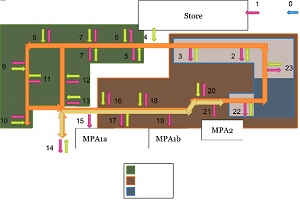
Findings and relevance
The study provides a structured way to compare AGV and buffer configurations under defined production assumptions. Its value is in supporting scenario analysis and planning discussions rather than supplying one fixed configuration for every production environment.
Any industrial application would require validation with the actual layout, demand, timing, operational constraints, and available data.
RESEARCH REFERENCE
This project was completed in connection with an MSc in Intelligent Automation at the University of Skövde.
Related capabilities
Project scope depends on the available data and operational requirements.
INDUSTRIAL WORKFLOWS
We can discuss the current process, available data, operating constraints, and whether a focused analysis or digital prototype would be a useful first step.